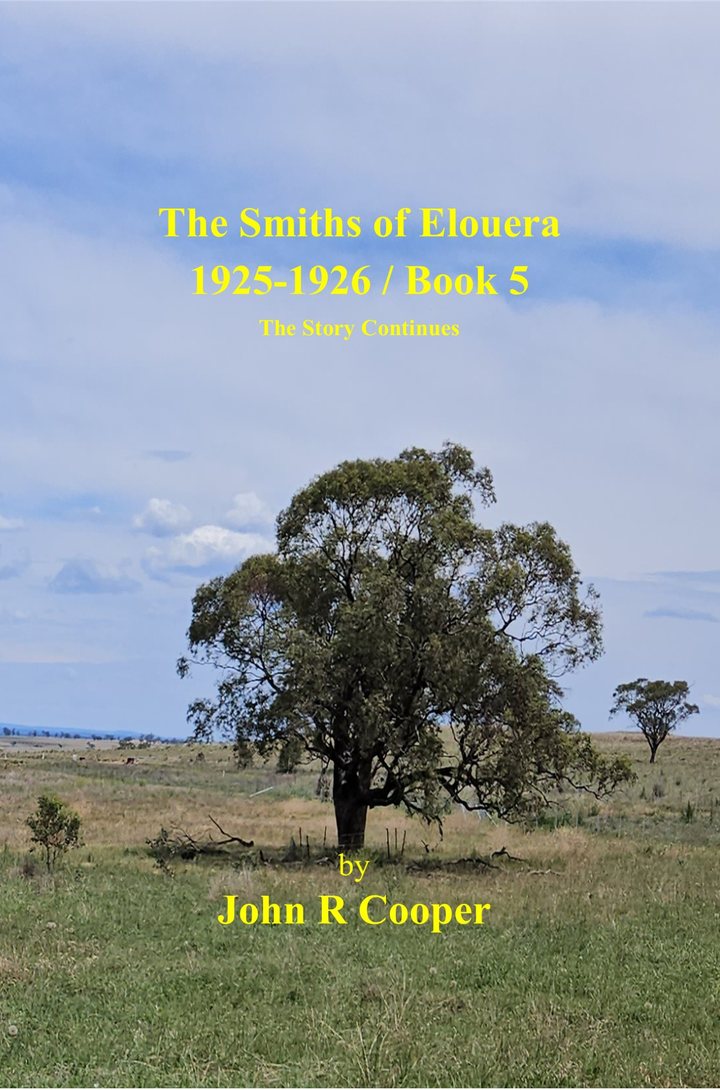
Book 5 · 1925–1926
The Smiths of Elouera
The Story Continues
by John R Cooper
Choose an edition
- HardcoverBuy Hardcover
- PaperbackBuy Paperback
- E-BookBuy E-Book
- AudiobookNarrated by a digital voiceGet Audiobook
About this book
This fifth book opens in the wake of great celebration. The double wedding of Ernest to Daisy and Alfred to Beth, so long anticipated, has been accomplished. Bob Clarke’s bagpipes have faded across the paddocks and the guests have gone home. As the morning mist lies over Elouera and the autumn of 1925 settles across the Central West of New South Wales, the real work begins: the quieter, more demanding business of building lives.
Ernest, who carried the weight of Rose’s death through the dark years of Book 3 and found in Daisy Walker a love he had not dared hope for, steps fully into the life his family and community need of him. He is a farmer, a councillor, a husband, a man of his district. Alfred and Beth, younger and more modern in their outlooks, discover that marriage is less a destination than a daily act of faith.
The world the Smiths inhabit is on the cusp of change. The Bruce-Page government in Canberra speaks of development and progress, Jack Lang has become Premier of New South Wales, motor cars are no longer novelties on the back roads, and the telephone has come to Elouera. Yet the deeper rhythms of rural life continue: the lambing, the shearing, the anxiety of a dry spring, the fellowship of Lodge nights and Sunday dinners.
There is grief too. James Roberts, the dignified, fading patriarch of the neighbouring property, carries the knowledge of his own mortality with grace, and his presence and his absence remind us what is inherited and what is relinquished. Ann, now a young woman of considerable ability and spirit, stands at the threshold of her own future. Her relationship with William Black deepens even as the question of her education and independence persists, and her story is left unresolved at this volume’s close.
Walter and Bridget continue to embody the steadiness, generosity and faith in the land and in one another that the series celebrates. When Walter speaks of “the legacy of the Smiths of Elouera”, the phrase reaches beyond property and bloodline toward something harder to name and more worth preserving.
Over fifty chapters, nearly a year of a family’s life is rendered in affectionate detail: the smell of a wool shed in summer, the formality of a Lodge meeting, the pride of a well-run harvest, the grief of a graveside in the rain. It is the story of ordinary days rather than great events. Welcome back to Elouera.